
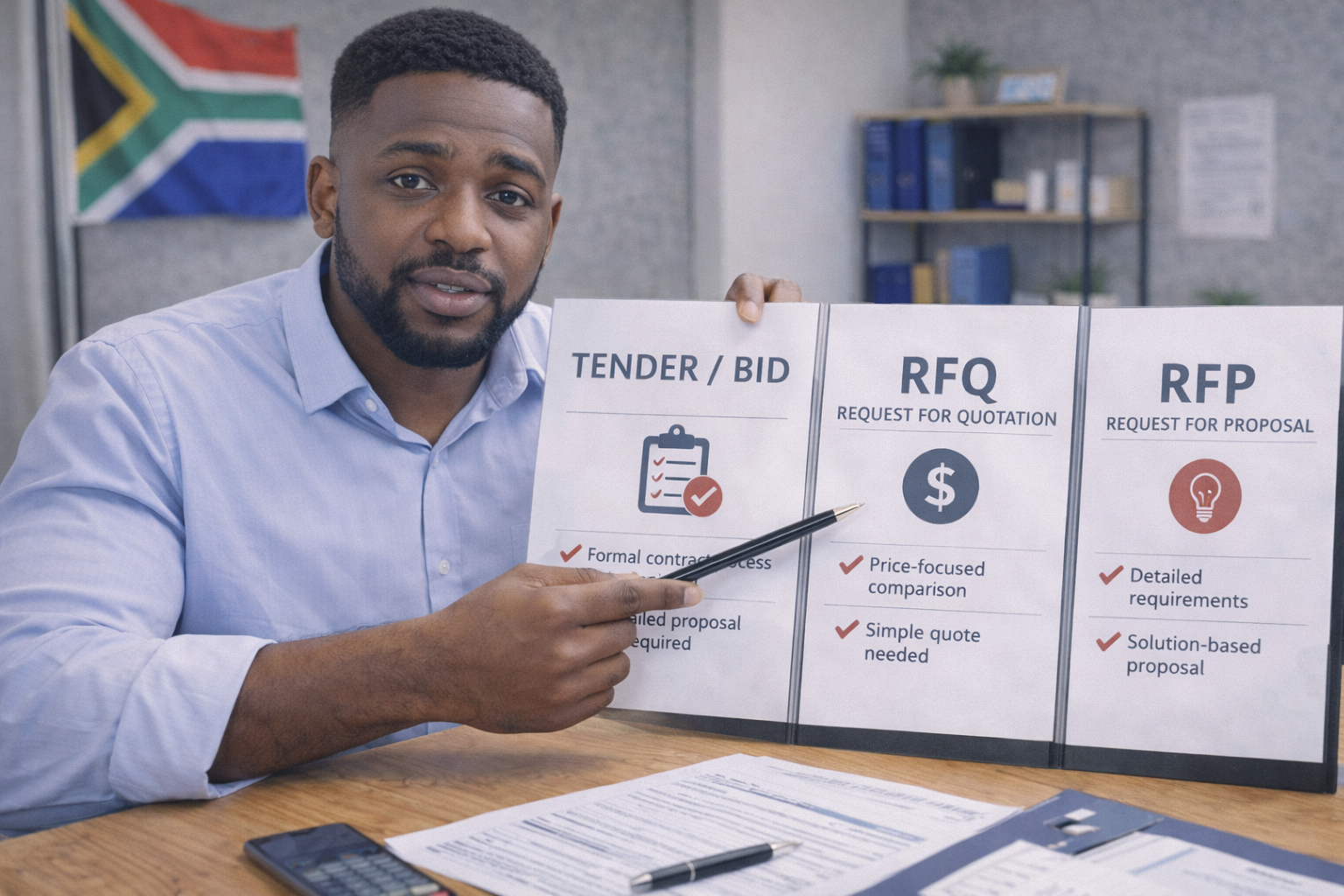
If you’re new to the world of public procurement, you’ve probably seen confusing terms like Tender, RFQ, and RFP in government documents and websites. But what do they actually mean, and how are they different?
Understanding these terms is crucial for Black South African entrepreneurs who want to supply government entities. Each process has different rules, expectations, and levels of complexity. This guide breaks it all down in simple, practical language.
1. What Are Tender, RFQ, and RFP?
Let’s define each term first:
 Tender
A Tender is a formal invitation by a government body asking suppliers to provide goods or services. It usually involves strict compliance documents, public advertising, and a competitive scoring system (like 80/20 or 90/10).
- Often used for large contracts (usually over R500,000)
- Requires registration on CSD and compliance documents
- Follows the Public Finance Management Act (PFMA) or MFMA
RFQ (Request for Quotation)
An RFQ is used when the government needs quick quotes for smaller purchases, typically below R500,000. It’s less formal but still follows basic procurement rules.
- Quick turnaround (sometimes 3–7 days)
- Requires price + basic documents (tax pin, B-BBEE, etc.)
- No public opening or lengthy evaluation process
- Often sent directly to pre-approved suppliers
RFP (Request for Proposal)
An RFP is used when a department knows what outcome they want—but needs you to propose the best way to do it. It’s more open-ended and usually used for consulting, strategy, ICT, and complex solutions.
- Focus on technical proposal + method
- Bidders must explain approach, timelines, and delivery models
- Used for projects that require innovation or problem-solving
Feature | Tender | RFQ | RFP |
|---|---|---|---|
Used For | High-value, competitive bids | Low-value, quick purchases | Complex, service based projects |
Process | Public, structured, strict | Informal, quicker | Flexible, proposal-focussed |
Scoring | 80/20 or 90/10 system | Based mostly on price | Weighted scoring incl. technical |
Volume of documents | High | Low | Medium to high |
Example | Road construction tender | Office Stationary RFQ | Building an e-learning platform |
3. When Should You Apply for Each?
As a Black-owned business or SME, you should position yourself for all three types of opportunities, depending on your current level of compliance and capacity.
Start with RFQs if you:- Are still small or just registered
- Need experience before applying for eTenders
- Can offer low-cost products or simple services quickly
Move to full Tenders if you:- Are CSD registered and tax compliant
- Have your B-BBEE, COIDA, and all documents ready
- Can deliver bigger projects or manage subcontracts
Pursue RFPs if you:- Offer services like IT, consulting, training, or strategy
- Can write detailed proposals and explain your value
- Want to compete on ideas, approach, and impact
4. What Documents Are Required?
Most procurement types still expect you to have:
- CSD registration (MAAA number)
- Tax compliance PIN
- B-BBEE affidavit or certificate
- Company registration (CIPC docs)
- Pricing schedule or proposal
Tenders and RFPs may also require:
- SBD forms
- Project team CVs
- Track record or past projects
- Methodologies and work plans
5. Common Mistakes to Avoid
 Confusing an RFQ for a Tender (and over-complicating your response) Submitting a tender response without all compliance docs Sending a quote for an RFP without a proper proposal Ignoring instructions in the bid document Missing submission deadlines (especially for RFQs)
6. Final Tips: Which Should You Focus On?
- New businesses should focus on RFQs to build experience and cash flow
- Growing SMEs should register on CSD and begin applying for Tenders
- Service providers with technical skills should target RFPs with strong proposals
- Whichever route you choose, always stay compliant, responsive, and professional
Government tenders are one of the most powerful ways to grow your business — if you’re prepared and compliant.
Use this guide to understand the different types of procurement and choose the one that matches your strengths.