
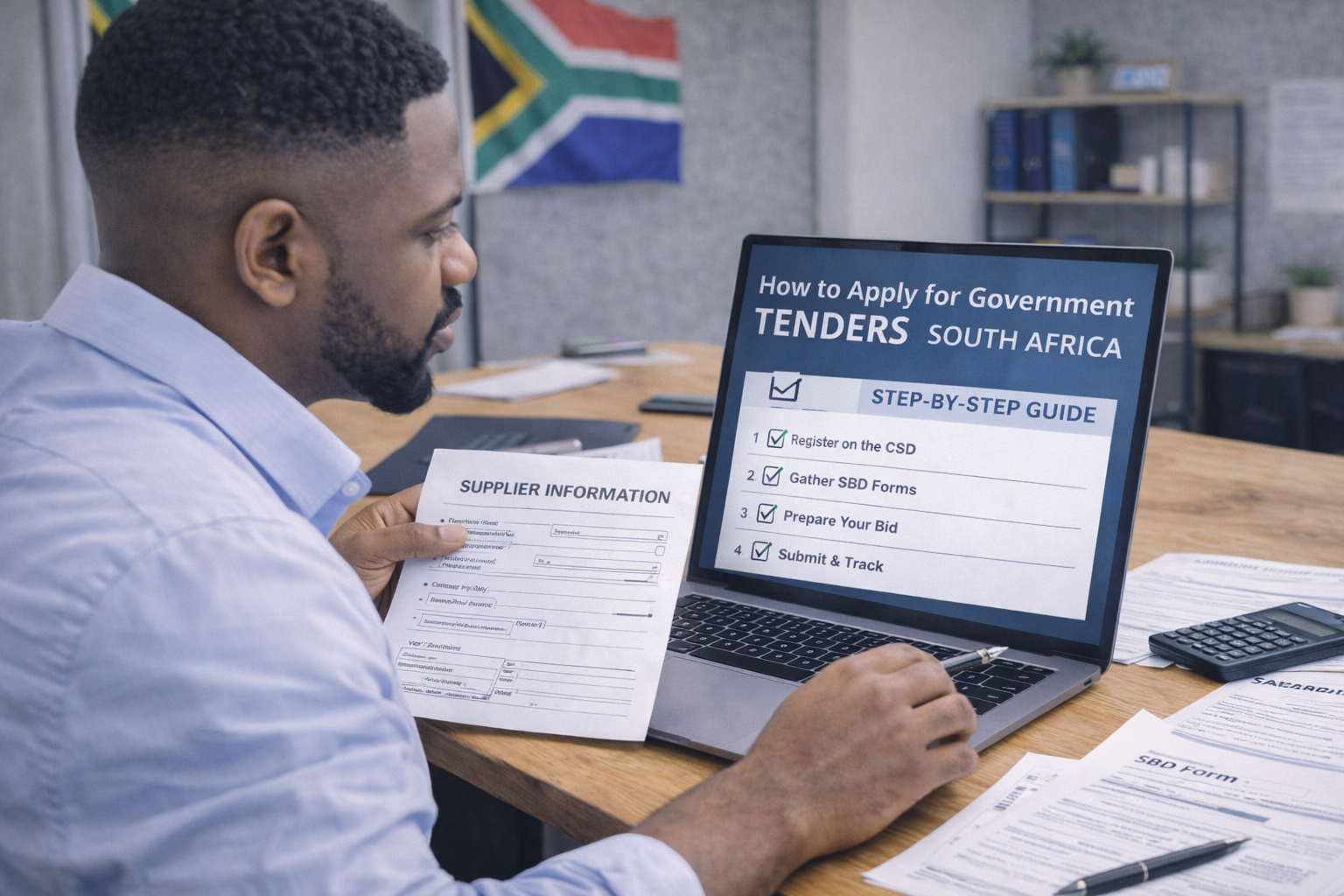
Government tenders are one of the most powerful ways for Black-owned businesses in South Africa to grow, gain credibility, and access consistent income. Whether you’re in construction, cleaning, catering, security, or IT—there are thousands of public sector contracts waiting for compliant businesses to apply.
But for many entrepreneurs, the process can feel confusing or intimidating. This guide breaks down the exact steps you need to take in 2025 to apply for government tenders in a clear and practical way.
1. What Is a Government Tender and Why Does It Matter?
A government tender is a formal request from a public institution (like a municipality, school, or department) asking suppliers to provide goods or services. These contracts are often worth thousands—or even millions—of rands.
Why it matters:
- It provides guaranteed payment (when done correctly)
- It allows small businesses to grow through access to large-scale work
- It helps build credibility in your industry
2. Who Can Apply for Government Tenders?
Any legally registered business in South Africa can apply, including:
- EMEs (Exempt Micro Enterprises) and QSEs (Qualifying Small Enterprises)
- Black-owned SMEs and cooperatives
- Sole proprietors with the correct documents
- Pty Ltd, CC, or NPOs with active CIPC registration
However, you must meet the minimum compliance criteria, including:
- Tax compliant
- CSD registered
- Proper documentation (see below)
3. Step-by-Step Process to Apply in 2025
Step 1: Register on the CSD (Central Supplier Database)
- Visit: https://secure.csd.gov.za
- You’ll receive a MAAA number (mandatory for most tenders)
Step 2: Get a Valid Tax Compliance Status (TCS) PIN
- Apply on SARS eFiling under “Tax Status” → “Tax Compliance Status”
- Share the PIN when submitting tenders to prove you are in good standing
Step 3: Prepare All Required Documents
- CIPC registration (or proof of ownership if informal trader)
- B-BBEE certificate or affidavit
- Proof of address
- Bank confirmation letter
- ID copies of directors/owners
- COIDA letter of good standing (for services involving labour)
- CIDB registration (for construction-related tenders)
Step 4: Search for Tenders Online
Use these official sources:
- National Treasury eTender Portal: https://www.etenders.gov.za
- Municipal websites (e.g. City of Cape Town, eThekwini, etc.)
- Provincial Treasury portals
- Our simplified eTender Portal
Step 5: Study the Bid Document Carefully
- Read the terms of reference, specifications, pricing schedule, and mandatory documents list
- Don’t leave any sections blank—incomplete bids are disqualified automatically
Step 6: Attend the Briefing Session (If Applicable)
- Some tenders require compulsory site meetings or briefings
- Always sign the attendance register to prove you were there
Step 7: Submit Your Bid on Time and in the Correct Format
- Double check submission deadlines, address, packaging and labelling
- If it’s online, ensure all documents are uploaded and acknowledged
- Keep a copy of your bid and proof of submission
4. Required Documents Checklist
 CSD Summary Report (with valid MAAA number) SARS TCS PIN B-BBEE Affidavit or Certificate Company registration docs (CIPC) ID copies of owners/directors Bank letter (not older than 3 months) Municipal account or lease agreement (proof of address) COIDA, CIDB, NHBRC (if applicable) Signed and completed SBD forms (from the bid pack)
5. Costs and Timelines
- Most tenders are free to apply for
- Some printed bid documents may cost between R50–R500
- Timelines vary, but most tenders close within 14–30 days of publishing
- Results are published within 30–90 days depending on the buyer
6. Common Mistakes to Avoid
 Submitting late or missing a compulsory briefing Leaving out mandatory documents Not signing forms like SBD 1, SBD 4, or pricing schedule Incorrect pricing or arithmetic errors Using expired documents (e.g. outdated COIDA or B-BBEE affidavit)
7. Final Tips and What to Do Next
- Keep all your compliance documents updated and stored digitally
- Apply consistently—even if you don’t win the first few
- Network at briefing sessions and learn from feedback
- Start with smaller local tenders before targeting national ones
- Focus on value and delivery—you’ll build a good reputation fast
Government tenders are one of the most powerful ways to grow your business — if you’re prepared and compliant.
Use this guide to take your next step and show that your business is ready to deliver.